Virtualization vs Containerization: What’s the Difference and Which One to Use?
In today’s fast-paced software development world, speed, efficiency, and scalability are non-negotiables. Whether you're setting up your development environment, deploying applications on the cloud, or building a DevOps pipeline, the choice between Virtualization and Containerization becomes crucial.
Let’s break it down in simple terms.
💡 What is Virtualization?
Virtualization is the process of creating multiple virtual machines (VMs) on a single physical machine. Each VM runs its own Operating System (OS) and behaves like a completely separate computer.

⚙️ How it works:
A hypervisor (like VMware, VirtualBox, or KVM) sits on top of the hardware or host OS and manages the VMs.
✅ Pros:
Full isolation of environments
Can run different OS types (Linux VM on Windows, etc.)
Secure and reliable for legacy applications
❌ Cons:
Heavy on resources (RAM, CPU)
Slower boot time
Not as portable
📦 What is Containerization?
Containerization is the modern approach where applications are packaged with everything they need to run – code, libraries, dependencies – into a container. Containers share the host OS kernel, making them lightweight and faster.

The most popular containerization platform is Docker.
⚙️ How it works:
A container engine (like Docker) manages and runs containers. These containers run as isolated processes but use the same OS kernel.
✅ Pros:
Fast startup (seconds!)
Lightweight and efficient
Easily portable across systems
Great for microservices and CI/CD
❌ Cons:
Less isolation compared to VMs
All containers must share the same OS type
Security concerns in multi-tenant environments
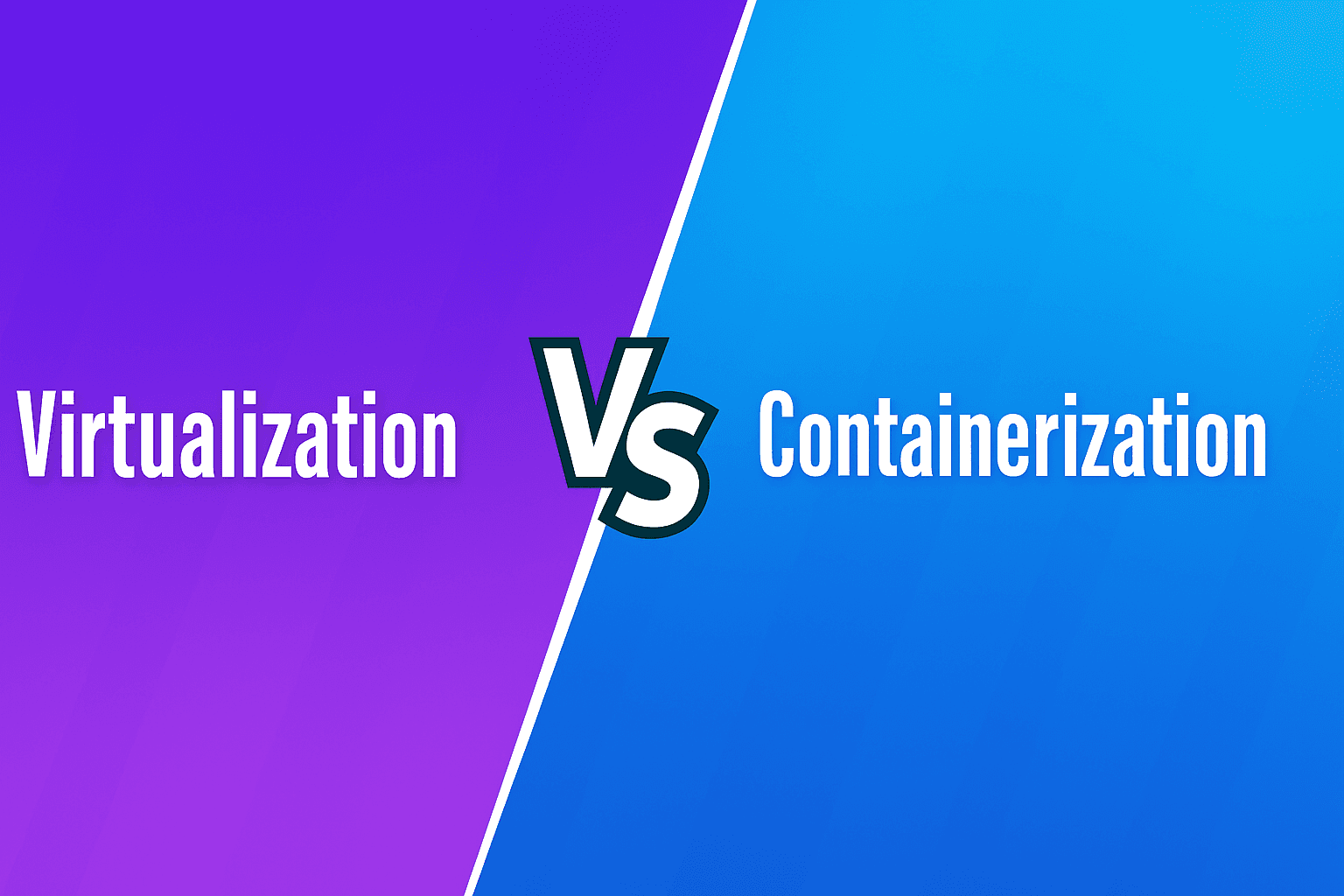
⚔️ Virtualization vs Containerization: Head-to-Head

| Feature | Virtualization | Containerization |
| OS Dependency | Each VM has its own OS | Containers share the host OS |
| Resource Usage | Heavy | Lightweight |
| Boot Time | Minutes | Seconds |
| Isolation Level | Strong (full OS) | Process-level isolation |
| Use Case | Monolithic apps, legacy software | Microservices, CI/CD pipelines |
| Portability | Moderate | High |
| Performance | Moderate to Low | High |
🚀 When to Use What?
✅ Use Virtualization When:
You need full OS-level isolation
You’re running different OS types on the same hardware
Security is top priority for sensitive enterprise workloads
✅ Use Containerization When:
You want to develop and deploy faster
You’re building cloud-native or microservices-based apps
You need easy scaling and portability
📌 Final Thoughts
Think of it like this:
Virtual Machines are like full-fledged apartments with their own plumbing and electricity.
Containers are like studio rooms in a co-living space – lightweight, fast, and efficient.
Both have their place in modern infrastructure. In fact, many organizations use a hybrid approach, running containers inside VMs to balance flexibility and security.